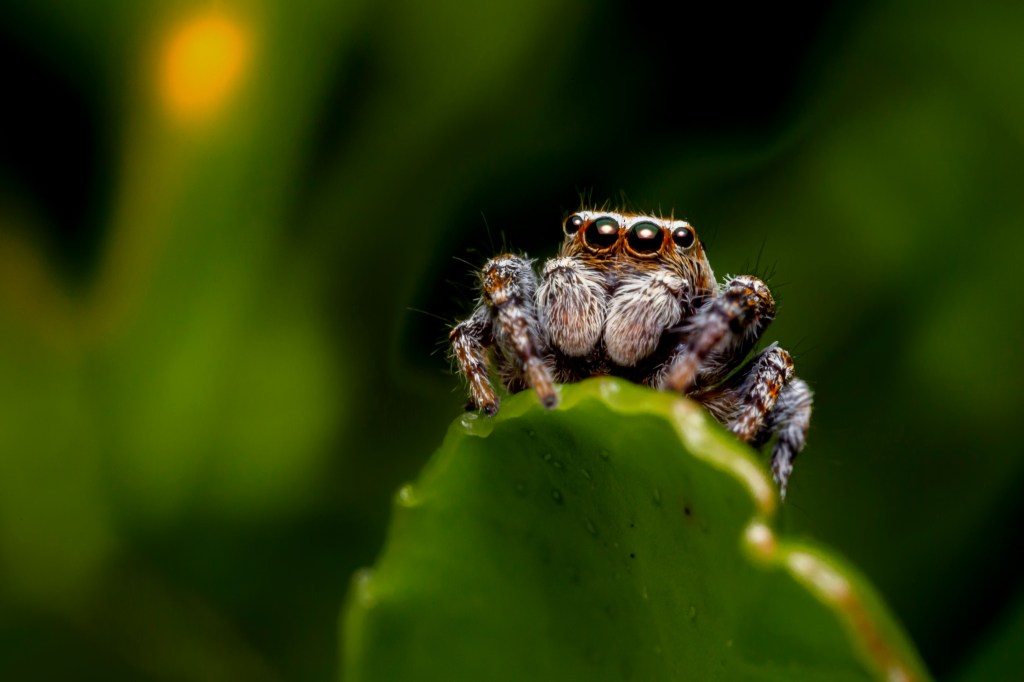
How to Handle Wolf and Jumping Spiders, and why they are important.
At dusk I go out to water the garden. Along the grassy edge of the corrugated metal garden bed, I see the long, tendril-like legs of spiders that bound around. I lean down to look, wondering if I should find some outdoor spider repellant that works. The small squat spiders catch my eye first. With their front-facing eyes, they turn in excitable circles. They jump inches across the grassy surface in consecutive leaps. Right at the grass’s edge, their lean counterparts look straight on, running in a high-speed chase almost too fast for my eyes to catch.
To you and me, they are the fast-moving arachnids we catch glimpses of while kneeling in our yards. Itch-inducing for some, these garden spiders might be the reason that you remember to put your gloves (and shoes) back on. To the North Carolina biologist, Pardosa Milvina and Habronattus Coecatus are only two of the species that help make up the vast Pardosa and Harbronattus genomes—the genomes related to what is commonly known as the Wolf and Jumping Spider. You’ll find these fast critters in the open, along with the grass spiders, crab spiders, and harvestmen you are likely to find in your North Carolina yard.
For a long time, I thought these species were the same thing. From my perspective, they seem similar. But biologically, they are more like cousins than siblings. While both are non-webbing spiders and natural predators, they take to the chase in different ways. (Their common names give away their biggest differences.) Jumping spiders use their small bodies in amphibian-like ways, turning and leaping towards their prey in jumps much longer than their body length. Wolf spiders run after their prey in a focused straight-forward chase, much like the dog-like mammals they’re named after.
It’s easy to want to eradicate these fierce little hunters. When there is a lot of “grub” around the garden, they show up in abundance. While generally solitary creatures, they congregate to the areas where the buffet-line of aphids, ants, flies and other insects is long. Spiders are the menacing, venomous creatures we were taught to hate and fear. You might think, what’s the best way to get rid of these guys?
But to our mutual surprise—it might be better for your garden to simply give them the space they need. As are all native species, these spiders are more friend than foe.
Here are three reasons to consider how you handle these creatures, before running to the spider killer:
- They Are Natural Predators
Both jumping spiders and wolf spiders act as natural predators to the pests in your garden and yard, eating the invertebrates that may consume and deteriorate the plants you cultivate. And, for those of you who are arachnid-averse, the good news is that while they may hunt in the open, they would like to leave you alone. These hunters pose very little threat to humans, nothing that a pair of gloves and closed toed shoes can’t handle. As Charlotte Glen, a local agricultural agent wrote in the Triangle Gardner, “Spiders are a Gardners Friend”.
- They are Prey to your Native Birds
While the variety of non-webbing spiders might be top of the food chain in the beneath the surface of the grass and garden plants, they are prey themselves to important native species. Birds like the Carolina Wren, along with the Five-Lined Skink and other native reptiles and amphibians, consume common spiders like these. While the skittery creatures are often those with negative connotations, their presence keeps a healthy, biodiverse food chain flowing.
- They Are Living Signs of Biodiversity
Like symptoms in the body, the inhabitance of creatures (or lack thereof) are indicators of the overall environment. A healthy amount of wolf or jumping spiders in your garden and yard are indicators of a biodiverse environment where are there is a plethora of other insects for the to hunt. And a healthy, biodiverse garden yard is full of pollinators and native plants and animals—and for the gardener, hopefully some good food as well.
While there are some risks of minor bites, hunting spiders are a natural part of your North Carolina yard and are rarely a source of pests, disease, or infestation for humans. Just be careful of the spiders in harder-to-reach places, like attics and basements, as those areas tend to house the spiders more harmful to humans, like the brown recluse and black widow. With a keen eye and respect, these fast-moving, stunt-fueled creatures will help keep your local ecosystem in balance and the pests out of your garden.
 Hannah Kiker
Leave a comment